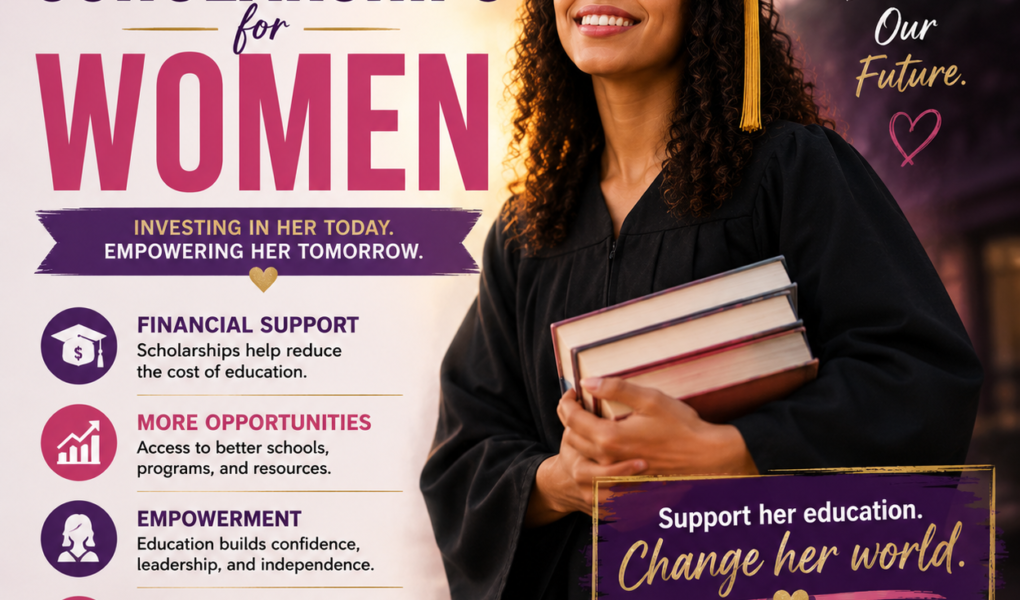
There is a quiet kind of courage that happens when a woman decides to return to school after years away. It may not look dramatic from the outside, but inside, it can feel like standing at the edge of a completely new life while carrying the weight of bills, children, work, past disappointments, family duties, age worries, and the fear that maybe the opportunity has already passed.
Many women want to return to school but feel stopped before they even begin. Some believe tuition is too expensive.
Some think scholarships are only for teenagers fresh out of high school. Some feel ashamed because they did not finish earlier.
Some left school because they had children, got married, cared for parents, moved countries, survived hardship, worked low-paying jobs, or simply had to choose family survival over personal dreams.
But the truth is this: education funding is not only for young students with perfect records and straight career paths.
There are scholarships for women returning to school, scholarships for adult women, grants for women going back to college, scholarships for mothers returning to school, education grants for women, mature student scholarships, women’s education funding, scholarships for women in the USA, UK scholarships for women, Canada scholarships for women, and Australia scholarships for women.
Many of these opportunities are designed for women who are restarting, rebuilding, finishing a degree, changing careers, or creating a better future after years of delay.
This guide will help you understand where to look, what types of funding exist, how to apply with confidence, and how to avoid the common mistakes that stop many women from getting the support they need.
Why Women Returning to School Should Not Ignore Scholarships and Education Grants
One of the biggest myths about scholarships is that they are only for young students going straight from secondary school, high school, or college into university. That belief keeps many capable women from applying for money that may actually be created for people just like them.
Scholarships for women returning to school are often built around life experience, financial need, leadership potential, career goals, community service, family responsibility, and the courage to continue education after interruption.
A woman may return to school after marriage because she wants financial independence. A mother may go back to college because she wants a better-paying career and more stability for her children.
A single mother may want to complete a nursing degree because healthcare offers long-term career growth. A woman who lost her job may decide to retrain for a field with stronger demand.
An immigrant woman may need a new qualification to rebuild her career in a new country.
A woman in her 40s or 50s may decide that she is not too old to begin again, especially if the career she once accepted no longer matches the future she wants.
Funders support women’s education because the benefits do not stop with one person.
When a woman earns a degree, certificate, diploma, or professional qualification, it can improve her income, confidence, career options, leadership opportunities, and family stability.
Her education can affect her children, her household, her workplace, and her community.
This is why many scholarships for mature women students, scholarships for career change women, and financial aid for women returning to school focus on more than grades. They look at potential, purpose, need, and impact.
For example, a single mother who wants to complete a nursing degree may be eligible for scholarships for single mothers, healthcare scholarships, local community scholarships, college bursaries, or state-based education grants.
A working woman who wants to move into technology may search for women in STEM scholarships, career-change scholarships, employer tuition assistance, online degree scholarships, and grants for women going back to college.
A woman who left school years ago may qualify for re-entry scholarships, adult learner scholarships, or scholarships for women completing a degree.
The important thing is to stop assuming that your age, family history, career gap, or past delay disqualifies you. In many cases, your story may actually make your application stronger because it shows resilience, responsibility, and a clear reason for returning to school.
CTA: Ready to stop searching alone and start finding real opportunities faster? Join the Opportunities for Women Founding Membership and get access to carefully researched scholarships, grants, fellowships, remote jobs, funding opportunities, and step-by-step guidance created for women who are ready to move forward.
Scholarships for Women Returning to School in the USA
In the United States, women returning to school can find several types of education funding depending on their age, income, location, field of study, school type, family situation, and career goal.
Scholarships for women in the USA may come from universities, community colleges, women’s foundations, professional associations, nonprofit organizations, state agencies, corporate foundations, local churches, civic groups, and community organizations.
Women who are going back to college should not only search for “scholarships for women.” That search is useful, but it is too broad. A better strategy is to search for scholarships based on your exact situation.
For example, you may search for adult learner scholarships, scholarships for women over 30, scholarships for women over 40, scholarships for single mothers, nursing scholarships for women, scholarships for women in STEM, community college scholarships, online degree scholarships, and state-based education grants.
Women in the USA may also find support through financial aid programs, school-based grants, employer tuition assistance, and private scholarships.
If you are applying to a college or university, ask the financial aid office about scholarships for nontraditional students, returning students, low-income students, women in specific majors, and students with family responsibilities.
Many women miss opportunities because they only search online and never ask their own school what is available.
Common Scholarship Categories for Women returning to School in the USA include:
- Adult learner scholarships for students who are not coming directly from high school
- Re-entry scholarships for women who paused their education and want to return
- Scholarships for single mothers who need help paying tuition, books, childcare, or school-related costs
- Scholarships for women in STEM fields such as technology, engineering, data, science, and mathematics
- Nursing scholarships for women entering healthcare careers
- Scholarships for women over 25, 30, 40, or 50 who are pursuing a new educational goal
- Community college scholarships for women starting with a more affordable pathway
- Online degree scholarships for women who need flexibility because of work or family
- State-based education grants for residents who meet income, school, or program requirements
- Employer tuition assistance for women who are working while studying
The documents you may need will depend on the scholarship, but many applications ask for similar materials.
You may need FAFSA information if you are applying for federal or school-based financial aid, proof of enrollment or acceptance, transcripts, a resume, recommendation letters, a personal statement, a financial need statement, and a clear explanation of your career goals.
Some scholarships may also ask for proof of residency, proof of income, community service history, or details about your family responsibilities.
The strongest applications usually explain why you are returning to school now, what you plan to study, how the scholarship will reduce financial pressure, and how your education will help you build a stronger future.
You do not need to pretend that your journey has been perfect. You need to show that your next step is serious, planned, and connected to a real goal.
Scholarships and Bursaries for Women Returning to School in the UK, Canada and Australia
Women in the UK, Canada, and Australia may not always see the word “scholarship” used in the same way. In some countries, funding may be called bursaries, grants, hardship funds, student support, mature student awards, education assistance, or training subsidies. This is why women returning to school should search using different terms, not just one phrase.
For the UK, women returning to education can look for bursaries, hardship funds, mature student support, university scholarships, charitable trust grants, career-change funding, and subject-specific awards.
Mature women students should search through universities, colleges, charitable foundations, professional bodies, local councils, and education support organizations.
Some funding may be based on financial need, while other awards may support women entering specific fields such as teaching, healthcare, social work, STEM, business, law, or public service. Women should also ask universities about widening participation support, childcare support, and hardship funding for students with financial difficulties.
For Canada, women returning to school can search for scholarships, bursaries, provincial grants, Indigenous women’s education funding, single mother support, mature student awards, university-based financial aid, college bursaries, and career training grants.
Canada scholarships for women may be offered by provinces, universities, colleges, women’s organizations, Indigenous organizations, professional associations, employers, and community foundations.
Women should search by province, school, field of study, financial need, identity, and career goal. For example, a woman in Ontario may find different funding than a woman in British Columbia, Alberta, Manitoba, or Nova Scotia, so location matters.
For Australia, women returning to school can search for university scholarships, TAFE support, mature age student scholarships, women in STEM scholarships, regional student support, single mother education grants, and career-change scholarships.
Australia scholarships for women may come from universities, government education portals, community organizations, professional associations, women’s leadership programs, and industry-specific training initiatives.
Women who want practical training should also explore TAFE and vocational education support, especially if they are preparing for a new career or trying to gain employable skills quickly.
To make your search easier, use these country-specific search ideas:
- UK: Search for “bursaries for women returning to education,” “mature student scholarships UK,” “hardship funds for mature students,” “charitable grants for women students,” and “UK scholarships for women career change.”
- Canada: Search for “Canada scholarships for women,” “bursaries for mature women students Canada,” “provincial grants for women returning to school,” “single mother scholarships Canada,” and “college bursaries for adult learners Canada.”
- Australia: Search for “Australia scholarships for women,” “mature age student scholarships Australia,” “women in STEM scholarships Australia,” “TAFE support for women,” and “career change scholarships for women Australia.”
- All countries: Search by your field, age, location, background, income level, family situation, and study format.
- Always verify: Check deadlines, award amounts, eligibility rules, required documents, and whether the scholarship is still open before applying.
CTA: If you want help finding scholarships, grants, fellowships, and paid opportunities without wasting hours on outdated websites, join the Opportunities for Women Founding Membership. It is created for women who want real opportunities, simple guidance, and consistent support as they build a better future.
How to Find and Apply for Scholarships as a Woman Returning to School
Finding scholarships for women returning to school becomes easier when you stop searching randomly and start using a clear process. Many women give up because they type one broad phrase into Google, see thousands of results, feel overwhelmed, and assume there is nothing for them. A better approach is to organize your search around your country, school, field, age, income, life situation, and education goal.
Here is a simple step-by-step process you can follow:
- Decide what you want to study. You do not need every detail finalized, but you should know whether you want healthcare, business, technology, education, social work, trades, law, public service, creative fields, or another pathway.
- Choose your country and school options. Scholarships are often tied to location, citizenship, residency, or school enrollment, so search based on where you plan to study.
- Search by your personal situation, not only by your course. Look for scholarships for mothers returning to school, scholarships for adult women, scholarships for mature women students, scholarships for single mothers, and grants for women going back to college.
- Look for scholarships based on age, gender, income, career field, location, and life experience. A woman over 40 returning to nursing should not only search for nursing scholarships. She should also search for scholarships for women over 40, healthcare bursaries, adult learner grants, and local community awards.
- Create a scholarship tracker. Use a simple spreadsheet or notebook with columns for scholarship name, country, school, deadline, award amount, eligibility, documents needed, application link, and submission status.
- Prepare your documents early. Gather transcripts, proof of enrollment, identification, financial documents, resume, recommendation contacts, and personal statement drafts before deadlines become stressful.
- Write a powerful personal statement. Your story should be honest, focused, and hopeful. You can talk about challenges, but do not make the whole essay sound like pain. Show growth, direction, and the future you are building.
- Ask for recommendation letters before the deadline. Give your recommender enough time and share your goals so the letter can support your application properly.
- Apply before the deadline. Do not wait until the final day because websites crash, documents go missing, and life happens.
- Follow up when appropriate. If the scholarship allows follow-up, send a polite message to confirm receipt or ask about the timeline.
Your personal story can be powerful without sounding desperate. Instead of only saying, “I need money,” explain what the funding will help you do. Connect your education goal to family impact, community impact, career growth, financial independence, leadership, and long-term contribution.
Strong Personal Statement Angles include:
- “I am returning to school to build a stable career after years of caregiving.”
- “I want to complete my degree so I can move into a higher-paying field.”
- “This scholarship will reduce the financial pressure that has delayed my education.”
- “My goal is to use my education to serve women, families, or underserved communities.”
- “Returning to school is not just a personal goal. It is a step toward rebuilding my future.”
A scholarship committee does not need a perfect life story. They need to understand why this opportunity matters, why you are ready, and how the funding will help you move forward.
Common Mistakes Women Make When Applying for Scholarships and How to Avoid Them
Many women miss scholarships not because they are unqualified, but because they make avoidable mistakes during the search and application process. The first mistake is assuming they are too old to qualify.
This is one of the most damaging beliefs because many scholarships for adult women, scholarships for women over 30, scholarships for women over 40, and scholarships for mature women students exist specifically for people who are not traditional young students.
Another common mistake is only searching for general scholarships. General scholarships can be very competitive because everyone applies for them.
Women returning to school should also search for specific opportunities based on motherhood, income level, career field, location, age, community service, immigration background, disability status, professional goals, or school type. A specific scholarship may receive fewer applications and may fit your story better.
Ignoring local scholarships is another costly mistake. Local women’s clubs, churches, community foundations, employers, civic organizations, colleges, and professional groups may offer smaller awards that are easier to access than national competitions.
A $500, $1,000, or $2,500 award may not pay for everything, but several smaller scholarships can reduce the burden of tuition, books, transportation, internet, childcare, and course materials.
Women also make the mistake of applying without reading the eligibility rules carefully. Before you apply, check the country, age, residency, school, field of study, income level, enrollment status, citizenship, and document requirements. If you do not meet the basic rules, use your energy on a better match.
Another mistake is using the same weak personal statement for every application. It is fine to reuse parts of your story, but each application should feel connected to the scholarship’s purpose. If the award supports women in STEM, explain your STEM goal. If it supports single mothers, explain how education will improve your family’s stability. If it supports career change women, explain why this new path matters.
Other mistakes include missing deadlines, not showing financial need clearly, forgetting to proofread, waiting until the last minute, and not applying because you assume you will not win. The solution is to build a simple system. Track deadlines weekly, prepare documents early, write a strong base personal statement, customize each application, ask someone to review your essay, and apply consistently.
Returning to school takes courage. Applying for scholarships also takes courage because it requires you to believe that your future is still worth investing in. You may not win every scholarship, and no honest person should promise guaranteed funding. But every strong application increases your chances, builds your confidence, and teaches you how to present your story with more power.
CTA: Do not let another deadline pass while you are still wondering where to find real opportunities. Join the Opportunities for Women Founding Membership today and get access to curated scholarships, grants, funding opportunities, fellowships, remote jobs, and practical guidance created to help women take action with confidence.
FAQ Section
1. Can women returning to school get scholarships if they are older adults?
Yes, women returning to school can get scholarships as older adults, depending on the scholarship rules, country, school, field of study, and eligibility requirements. Many scholarships for women returning to school are designed for adult learners, mature women students, women over 30, women over 40, women over 50, career changers, and women who paused education because of work, family, caregiving, financial hardship, or life changes. Older students should not assume they are disqualified because of age. Instead, they should search for mature student scholarships, adult learner grants, re-entry scholarships, bursaries for women returning to education, and financial aid for women returning to school.
2. Are there scholarships for mothers going back to school?
Yes, there are scholarships for mothers returning to school, including support for single mothers, low-income mothers, working mothers, and mothers who need flexible study options. These scholarships may come from colleges, universities, women’s foundations, nonprofit organizations, community groups, professional associations, and local charities. Mothers should search for scholarships for single mothers, grants for women going back to college, education grants for women, childcare support, hardship funds, and school-based bursaries. A strong application should explain how the education program will improve career stability, income potential, family security, and long-term opportunities.
3. Can I get scholarships if I want to study online or part-time?
Yes, some scholarships allow online or part-time study, but the rules vary. Many women returning to school need flexible programs because they are working, raising children, caring for family members, or rebuilding after a long education gap. When searching, use phrases such as online degree scholarships, part-time student scholarships, adult learner scholarships, flexible study bursaries, and scholarships for women completing a degree. Always read the eligibility rules carefully because some awards require full-time enrollment, while others accept part-time, distance learning, online programs, community college, TAFE, vocational training, or professional certification programs.
4. What documents do I need to apply for scholarships as a returning student?
The documents you need will depend on the scholarship, but many applications ask for proof of enrollment or admission, transcripts, a personal statement, recommendation letters, resume, financial need statement, identification, proof of residency, and details about your course or career goals. In the USA, some school-based aid may also require FAFSA information. In the UK, Canada, and Australia, you may need documents related to income, citizenship, residency, school acceptance, or financial hardship. The best approach is to create a scholarship folder early so you are not rushing when deadlines arrive.
5. Where can women in the USA, UK, Canada, and Australia find real scholarships?
Women in the USA, UK, Canada, and Australia can find real scholarships through university financial aid offices, college websites, government education portals, women’s foundations, charitable trusts, professional associations, community organizations, employer tuition programs, local councils, provincial funding pages, TAFE or vocational education offices, and nonprofit organizations.
Search using specific phrases like scholarships for women returning to school, UK scholarships for women, Canada scholarships for women, Australia scholarships for women, scholarships for mothers returning to school, scholarships for women over 30, scholarships for women over 40, and scholarships for career change women. Always verify the deadline, award amount, eligibility rules, and application requirements before applying.
Returning to school is not a sign that you are behind. It is a sign that you are still willing to grow, rebuild, learn, and fight for the future you deserve. Whether you are in the USA, UK, Canada, or Australia, scholarships for women returning to school can help reduce the financial pressure and make your next step feel more possible. Start with one search, one tracker, one personal statement, and one application.
Then keep going. Your age, past delay, family responsibilities, or career gap do not erase your potential. With preparation, consistency, and the right support, you can return to school with more confidence and take the next step toward a stronger future. For ongoing curated opportunities and practical support, join the Opportunities for Women Founding Membership and stop searching alone.